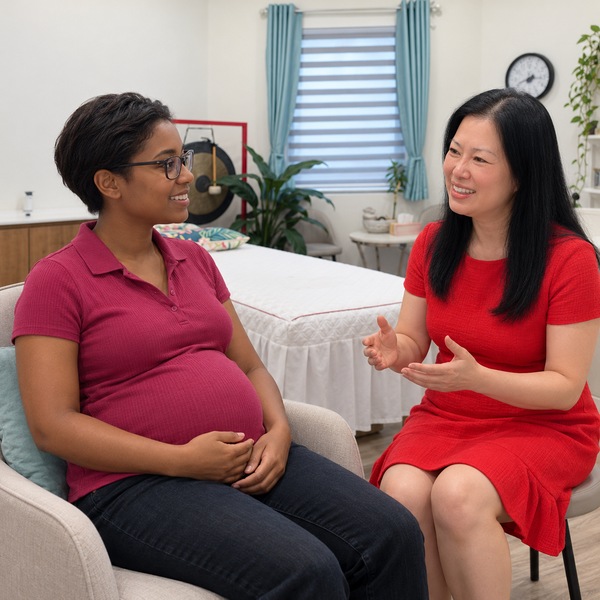
I see women weekly from about thirty-six or thirty-seven weeks, and a proportion arrive on a GP or midwife referral at term. If you have one, bring it with your maternity notes: I want your dates, who is leading your care, and anything being monitored.
What the appointments are. Short, side-lying with pillows, light needling, with the points that are avoided in pregnancy avoided. I ask how many weeks you are at every appointment rather than working from memory, and I write to your midwife or obstetrician.
What I will say. Women generally report sleeping better and feeling more settled. Several tell me it is the only appointment in the fortnight where nothing was measured and nobody was worried, and I think that has value.
What I will not say, and I get asked most weeks. That it brings labour on, that it shortens labour, that it reduces the chance of a caesarean, or that it avoids induction. The trials are limited and inconsistent. Saying any of it would be unsubstantiated — and there is a worse consequence than that. If a woman postpones a recommended induction because she believes an appointment with me will do the job, the risk falls on her baby. I am not prepared to be part of that.
Induction is your maternity team’s decision, made on medical grounds, and I will support it rather than work around it.
What I will do instead of making claims. Treat the things that are actually making the last month hard: the pelvis, the low back, the ribs, the hands that go numb overnight, and sleep in whatever form is still available. Refer to a pelvic health physiotherapist where the pelvis is the main problem, because they have specific management for it. And write to your midwife or obstetrician so nobody is working from a partial picture.
Ring your maternity service for reduced movements, bleeding, fluid loss, severe headache, visual change, upper abdominal pain or sudden swelling. The clinic is in Lane Cove, opposite the library.
